Write the wiki
Decisions and open questions
Record each decision in the page it affects with who decided, when and what was passed over, keep open questions with their owners, source your facts, and ask the wiki what was decided.
A wiki should let anyone see what is settled, what is still open, and why. NimWiki records both inside the pages they affect, so the reasoning sits next to the subject it explains.
What belongs in the wiki
- Decisions and their reasons: what was chosen, who chose it, when, and what was not chosen.
- What people asked for: preferences, constraints and the quality bar, in the words of the person who set them.
- Open questions: what is not decided yet, who owns it, and where it stands.
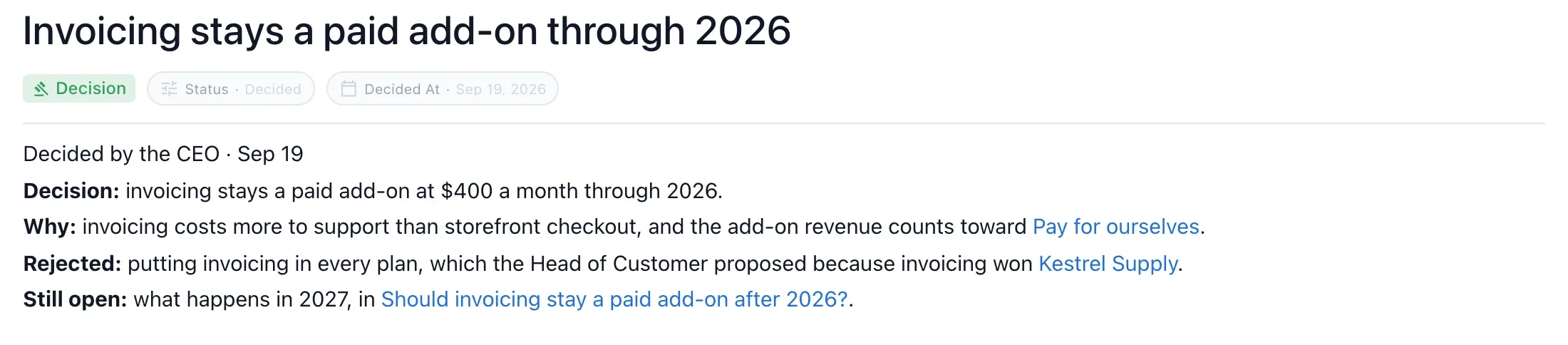
- Context for the whole problem: the markets, competitors, customers, options and people you weigh, with each fact sourced and dated.
- Hard-won lessons: a failure someone would repeat, with the rule it taught.
Task lists, status updates and meeting notes belong in your other tools. The wiki links to them.
Capture what you decided
At the end of a working session, ask:
Capture what we decided.
The agent goes through the session and writes:
- each decision as a marked sentence in the page it affects, with who decided, the date and what was not chosen
- each open question with its owner
- context a reader would need to see the whole problem
It extends existing pages and creates a page only when none fits. It ends by listing the pages it changed, or says there was nothing to record. It never invents a decision, a reason or a quote.
In Claude Code the plugin reminds the agent once, at the end of a session with a commit, a plan or several file edits, to capture what you decided. Codex does not run the reminder, so ask it yourself.
You can narrow it: “capture what we decided about pricing.”
How a decision is written
A decision is one sentence, wrapped in brackets and followed by its attributes:
[We launch in the United States first.]{decided by="Dana Lee" email=dana@example.com on=2026-10-21 over="Europe first"}| Attribute | Meaning |
|---|---|
by | Who decided |
email | Their email, so every decision a person made can be found |
on | The date |
over | What was not chosen |
The page shows a small chip before the sentence and a faint line after it with who, when and what was passed over. Mark only the sentence itself, never a whole paragraph, and do not put a decision in its own box or section. The sentences around it carry the reasoning.
On a local wiki the name and email come from your git settings (git config user.name and git config user.email). When your own words in the session support the decision, the agent adds a citation that quotes you and links to where you said it. Quotes come from Claude Code session transcripts, on your machine.
When a decision changes, rewrite the sentence and say what it replaced and when, rather than adding a second, contradicting one.
How an open question is written
The same form, with open and the person who owns it:
[Do we need a mobile app at launch?]{open by="Dana Lee" email=dana@example.com}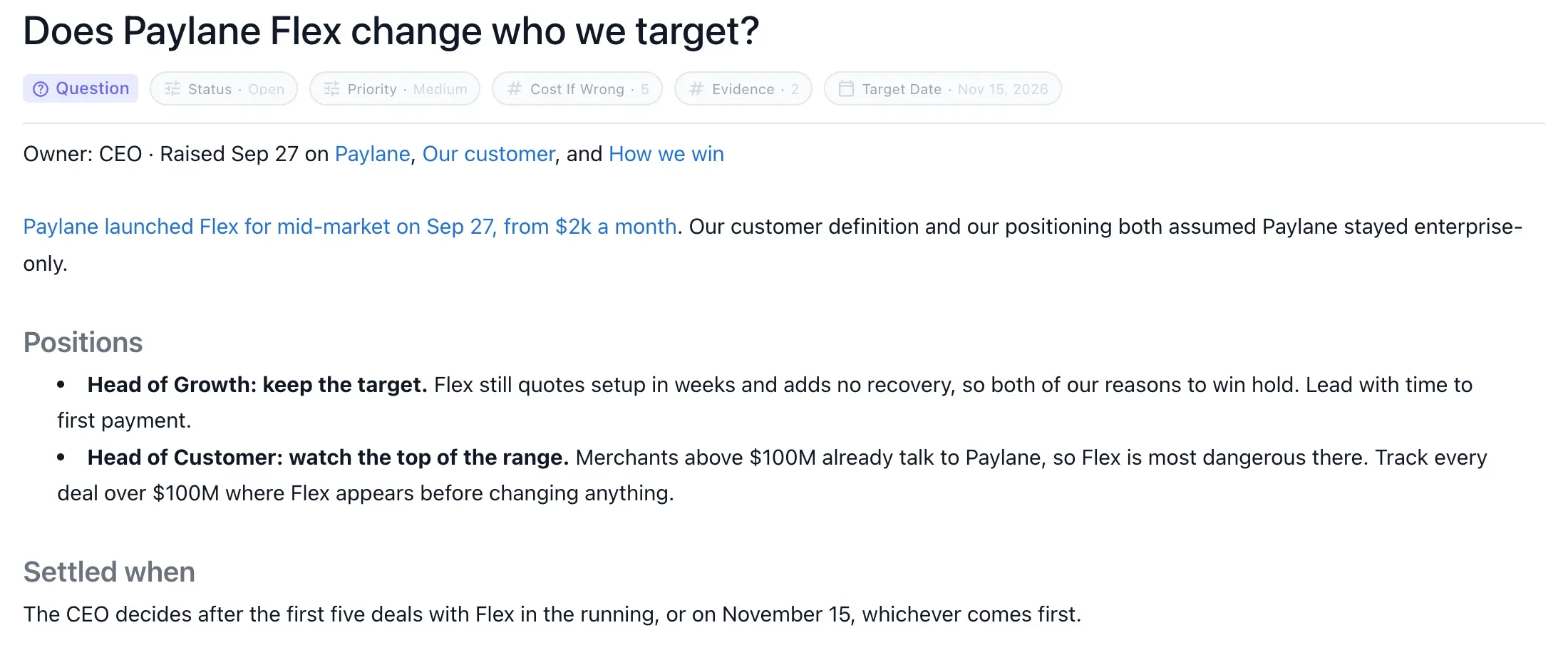
A page or a piece of work can own a question too: {open by="Pricing study"}. When it is answered, change the mark to decided with the date and what was not chosen.
To put a question to named people and collect their answers in the page, use a decision block.
Facts with sources
Facts you weigh (prices, market sizes, limits, what a competitor ships) carry a source and the date you checked it. Cite a web page or document as a link titled cite, and the page lists its sources at the bottom:
Acme's entry plan is $12 per seat ([Acme pricing](https://example.com/pricing "cite"), checked 2026-10-01).Keep what was decided, what was observed and what is a guess apart. A guess is never written as a decision.
Ask what was decided
Before you start on an area, ask:
What did we decide about pricing?
Why did we choose partners over a direct sales team?
What is still open for the launch?
The agent searches the wiki’s decided and open marks, then reads the few pages that answer best. It answers with each decision’s owner, date and what it was chosen over, and each open question’s owner, names the pages it used, and tells you when a page is marked outdated. If the wiki has nothing on the question it says so, and labels anything it answers from elsewhere.
The agent also checks the wiki on its own before design work or a larger change in an area the wiki covers.
An index of decisions
When the agent sets up a wiki it adds a Decisions page that links to every decision and open question, so a newcomer can catch up in a few minutes.
Pages that explain code
In a code repository, a page can name the code it explains in its paths field, as folder globs such as src/billing/**. Before changing that code the agent reads the page, and after a change it updates the page or marks it outdated with a line saying what changed.